

If you’re invested in a long-term managed fund like KiwiSaver, the short answer is hardly ever.
Provided you’re in the correct fund type to match your risk profile, there’s little to be gained by obsessing over your balance. In truth, it probably does more harm than good. That tends to result from people panicking and changing fund types at the wrong time.
Having said that, it is difficult to resist a little peak. It’s kind of like passing a car accident without gawking. You know you shouldn’t, but you do anyway.
Human nature is a tricky bit of business, particularly when it comes to money.
There’s a vast chasm between practice and theory regarding investor behaviour.
That’s mainly because investors fear the loss of a dollar more than they celebrate the gain of $1. It’s called “loss aversion,” a costly condition for investors on the jumpy side.
Over the past month, the Trump-fuelled whipsaw in the markets has undoubtedly cemented significant losses for investors who lost their nerve and fled high-growth and aggressive funds like a house on fire.
Most retail investors, like the three million that make up KiwiSaver, are locked into investment strategies determined by their fund managers, but technology has unlocked some power for them by allowing online switching.
The removal of ostensibly smarter gatekeepers is both a blessing and a curse. On the one hand, it allows investors agency over their funds, but it also introduces a level of risk where there wasn’t previously.
Twenty years ago, investors who wanted to start moving their funds around likely did so through a broker or advisor, who would have advised them (for better or worse) before executing a trade.
I confess that I haven’t been able to completely ignore the news or my balance because of my interest in the markets. The temptation to see the real-world impact at a personal finance level was too firm, however grim.
As I expected last week, it was a punch to the stomach.
This week, and who would’ve thought it, there’s been a pleasant rebound with a buoyancy fuelled by a 90-day pause in Tariffs.
For how long, who knows? President Trump changes direction more than an ADHD child at Disneyland.
Know your reason for being invested and your time frame
Equity markets were running red-hot even before the Trump-induced rally and subsequent sell-off.
All those tech behemoths like Amazon, Apple, and Tesla (pre-Elon DOGE disaster) were at thrilling highs. Because those big tech companies dominate the weightings of most aggressive and high-growth portfolios, which track indices like the S&P 500, Dow Jones, and Nasdaq, it was an avalanche when they fell in value.
I did think it was too good to last, and I did think about moving into conservative funds heavy in cash. I didn’t. Why?
Because the duration of my investments dictated a long-term approach, I took my lumps, as all high-growth investors likely did, unless they switched.
Moments like these are reminders to ensure you’re in the right fund for your profile and reasons for investing. Know your goals, and choose a time-appropriate fund with a risk you can swallow.
Untrained investors, including a lot of 20-something men, place themselves in the highest-risk fund, thinking that will make them the richest. They aren’t wrong, but only if they hold the course and don’t enter into their retirement years when the markets crash.
During the COVID market meltdown and several others since then, many panic-stricken investors have made the mistake of switching fund types at the worst time, crystallising their paper losses by moving into lower-risk, lower-returning funds, only to see the one they just left rally and recover.
Those closer to or in retirement don’t have that luxury if they withdraw their funds as income. It is a bitter pill to swallow, but time is not on your side.
This is why KiwiSaver providers and fund managers give you recommended time frames for investing.
Typically, the time frame for those higher-yielding long-term funds is 10 years or more. The risk and return reward reduce with short time frames.
For context: New Zealand’s Financial Markets Authority mandates the following conservative long-term annual averages for use in KiwiSaver calculators and tools to predict outcomes at 65.
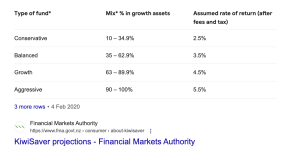
These numbers may seem low compared to actual returns over the past decade. However, remember that they are based on long-term historical data designed to give investors realistic expectations.
It’s essential to look at the big picture and take a deep breath amid all the turmoil.
And if you zoom out even further, investment prospects and potential run much deeper than your KiwiSaver and Sharesies account. On a day-to-day basis, the minutiae of personal finance habits that make up your whole financial position can propel or destroy what you are trying to achieve long-term.
It all comes down to goals.