

This is the second of five questions I am tackling on request by a group of Otago students who are graduating soon or entering the second phase of their education.
The question was: “How should I begin investing with limited funds?”
Great question.
Many people interested in ‘investing’ forget that they probably already are via their KiwiSaver accounts. I appreciate this is not as exciting as having your own Sharesies account but it’s a damn good starting point.
Here’s why:
When KiwiSaver was first rolled out in 2007, it came with a $1,000 sweetener.
Anyone who opened an account at that time received $1,000 as a “kick-start” including children. Sadly, this is no longer available as a result of successive governments tinkering with the structure of KiwiSaver.
If you were one of the thousands of kids whose parents cashed in on this offer, you’ve hopefully been made aware by either your parents or your provider.
Even if you, or your parents, didn’t contribute a cent more than, the $1,000 will likely have doubled over 18 years, less tax and fees.
Check your balance if you don’t know what it is yet. If you don’t know who has your funds, check with Inland Revenue.
For those parents who contributed regularly into that account at a rate of $100 a month, that seed fund of $1,000 over 18 years, could be worth four times as much! There’s a high reward to that $3-a-day saving habit.
See how the numbers stack up here using this investment return calculator!
Before you switch off and accuse me of not answering the question, bear with me a little longer. There’s a reason why I’ve taken a slight detour into KiwiSaver on this one.
KiwiSaver may not be as sexy as a Sharesies or Crypto account (and by the way, they are not mutually exclusive) but it is a good starting point for building on your investment nous.
Equally, you may decide, after taking some time to see where you’re at with KiwiSaver, that you should focus on other things in your life, and leave investing to the experts.
As a managed fund, KiwiSaver takes a lot of stress off the individual investor. So long as you have chosen your fund type appropriately, your provider, the correct tax rate and you’re contributing smartly AND aren’t paying too much in fees, you’re mostly sorted.
It sounds easy enough but you’d be surprised how many investors don’t have a clue about these basics, and I’m talking about people who probably have $30-$40k in their accounts too.
Getting those settings right is not rocket science and there are many free tools to help you get that one sussed. Sorted.org.nz and MoneyHub are great references too.
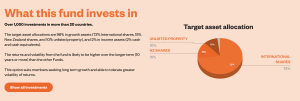
Once you have locked those down and are feeling more comfortable – and confident to move on – use your KiwiSaver fund in a deeper way to build out your investment knowledge. Understanding things like the asset allocation and what stocks and bonds you’re invested in and the average annual returns will be helpful when it comes to building your own portfolio outside of KiwiSaver.
You can find all this on your provider’s website under the Fund type that you’re invested in or else in the documents section.
Here’s an example below.
Some other required reading to help entrench your knowledge:
Your annual member statement: a personalised report showing your fund’s performance and how you’re tracking for retirement. You’ll see how much you’re on track to have by age 65 and what that will be on a weekly basis. If it’s not enough, let that serve as a wake-up call to dial up your contributions or come up with a wealth creation plan that hits the mark for you.
It’s no secret that New Zealanders are woefully behind most OECD countries in terms of retirement savings rates. Remember that you can contribute 3, 4,6,8, or 10% of your salary once you are gainfully employed and before you are saddled with a mortgage or other debts. You can always dial down your contributions if leaving you with nothing to pay your bills.
The Product Disclosure Statement: This is compulsory reading for every new KiwiSaver member. Sadly, not many individuals bother to read this. Forcing yourself to do so will pay off. You’ll learn more about how your fund is managed, by whom and how it all works in practice.
The quarterly fund update; a short sharp overview of how your fund has done that quarter reflecting any changes to the fund. It is a basic summary but useful at a glance and shows your top 10 holdings as well. You may find it interesting to see what companies you’re invested in
The Statement of Investment Principals and Objectives: This document contains a more detailed and nuanced breakdown of investment goals, methodology and what your fund manager is doing to grow your wealth in line with core objectives. Don’t start with this one if you don’t know much else as it’ll probably put you off. Proceed slowly.
Not many of you will tackle the recommended reading list but I can guarantee if you do, and you have understood it, you’ll feel 100% more confident about starting an investment fund outside of KiwiSaver. Don’t be scared off by any industry jargon and terms.
TIP: Use ChatGPT to translate things you are confused about or seek clarification from your fund manager or someone more knowledgeable than you.
The old days
Before the onset of DIY investment platforms like Shareies, Hatch or Flint, you had to go through a financial advisor. They used to have very high minimum investment amounts in the order of $25,000. On top of the high threshold amount for just getting started, you had to pay advisor fees. These usually came out of your portfolio whether it was earning or losing money and were calculated as a % of the balance. At the low end, it would be around .25% and at the high end 2.25%. Ten to 15 years ago, there wasn’t much attention paid to fees and few tools to figure out the compounding impact of those fees.
Today there is total transparency and blessedly way more public focus on the industry and what it charges.
How much do I need?
As Sharesies and the like love to tell you, you can invest for as little as $5 on some of these DIY platforms. Whether it makes sense to do so is another matter.
If you have credit card debt, you don’t have a decent emergency fund and/or are living pay cheque to pay cheque, or student loan cheque to cheque, investing $5 a week however cool may not be the best use of your money.
On the other hand, if you’re debt-free, you have a rainy day fund, and know how to budget, there’s little to stop you.
Options are a good thing in life and investing
One way to start investing outside of KiwiSaver is to use a parallel investment fund with your provider or else a competitor. The benefit of doing this is that they will mostly be diversified (in theory less risky for you) and you won’t have to make hard decisions about what stocks to invest in personally. It depends who you invest with but the start-up amount typically varies from $100 to $250.
Simplicity is one example of a fund manager who runs mirror funds. You could have a high-growth KiwiSaver fund (no touch till retirement) but also have an investment fund Conservative, Balance, Growth, High Growth (all diversified) and or single sector funds NZ Share, NZ bonds, International Equities (hedged or unhedged) as an example.
If you want to build your own portfolio, you’ll need to open an account with the likes of Sharesies, Hatch or Flint where you can DIY. They also offer pre-build funds from other providers and the option to pick and choose so you have agency in building diversified funds from different fund managers.
Which route you go depends entirely on your own objectives and knowledge levels.
Get started
Like most things in life, the hardest part is usually just getting started. If you’re confused, lacking in confidence and really feeling like you’re going in blind, but still determined to invest, you are probably best off investing via low-cost fund manager like Simplicity or Kernel Wealth. You can also buy an ETF on SmartShares and there are a range of them on offer. I won’t get into ETFs here but you can Google that easily enough and read up on SmartShares website.
In summary, before you plunge head first into the investment space I suggest you use your KiwiSaver account as a learning ground to understand the basics, and then build on that knowledge by doing deeper into what your fund is invested in (and how) by reading those recommended documents above.
First and foremost understand your reasons for wanting to invest then peg a time frame to it, research the risk and return and start feeding the beast. And remember to think about the big picture to ensure you aren’t investing money that might be better off somewhere else.
The information contained in the blog above is purely informational and should not be construed as personalised financial advice. Please seek a professional and authorised advisor if you require professional advice.